What Does Trance Feel Like? Hypnosis Is More Familiar Than You Think
One of the most common misunderstandings about hypnosis is that entering trance is difficult.
People sometimes imagine that something dramatic is supposed to happen. Their mind should suddenly shut off. They should feel completely different. Maybe they should lose awareness of the room or stop knowing what is happening.
Usually, none of that happens.
Trance can actually feel surprisingly normal.
In fact, you have probably experienced versions of it many times today without thinking about it.
You Already Know What Trance Feels Like
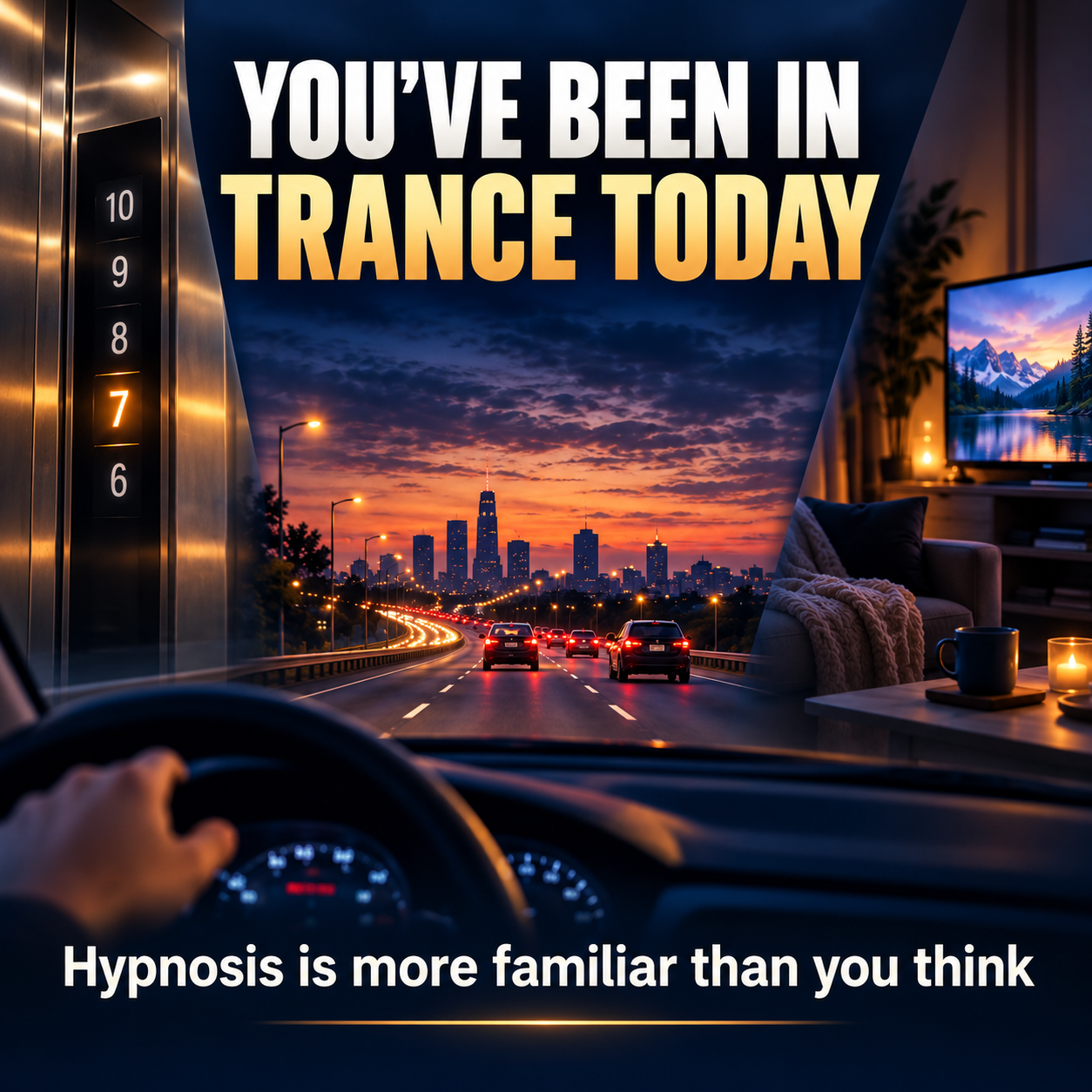
Think about driving home on a familiar route.
You are driving, responding to traffic, stopping at lights and making turns. Then suddenly you realize you have gone several miles and weren't really thinking about the drive at all.
You weren't asleep.
You weren't unconscious.
You were still capable of responding if something happened.
Your attention had simply shifted.
Or maybe you've been watching a movie or television show and become so absorbed in it that someone in the room says something to you.
A few seconds later you look over and say, "What?"
You heard a sound, but your attention was somewhere else.
Even an elevator can be an example.
You step inside, press the button and watch the numbers slowly change. Your mind wanders for a moment. The doors open and there can be that brief second where you have to remember whether this is your floor.
None of these experiences are particularly mysterious.
They are forms of focused attention and absorption.
That is one way of understanding trance.
Hypnosis Is Intentional Trance
The biggest difference between those everyday experiences and hypnosis is intention.
The drive home happens automatically.
Getting absorbed in television happens automatically.
Daydreaming while staring out a window happens automatically.
In a hypnosis session, we are deliberately creating the conditions for that inward focus.
You are not being "put under."
I am guiding you into a state that your mind already knows how to enter.
And then, instead of simply watching a television show or thinking about what you're having for dinner, we use that attention for something useful.
Depending on the session, that might mean exploring a memory, working with an emotion, connecting with an inner part of yourself, imagining a future possibility, exploring symbolic material, or having an experience such as a Past Life Regression or Soul Journey.
The trance itself is really just the doorway.
"But I'll Still Be Thinking, Right?"
Yes.
This surprises people.
You can be in hypnosis and still have thoughts.
You might think:
Am I doing this correctly?
Did I just make that up?
Why did that image appear?
I can still hear the air conditioner.
That doesn't necessarily mean hypnosis isn't working.
Your conscious mind doesn't disappear.
For most people, it remains somewhere in the background observing what is happening.
I sometimes describe it as having two things happening at once.
There is the part of you experiencing the journey, and another part that knows you're sitting in a chair having the experience.
That's perfectly normal.
You Don't Have to See Everything
Another misunderstanding is that hypnosis should look like a movie playing inside your head.
For some people, it does.
They may see places, faces, colors and scenes very clearly.
Other people experience things very differently.
You might get a physical sensation.
You might hear a word.
You might suddenly know something without knowing why.
You might get a vague impression that gradually becomes clearer.
You might feel an emotion before you understand where it is coming from.
None of those ways of experiencing hypnosis is better than another.
One of the things I pay attention to early in a session is how you naturally process information rather than trying to make you experience hypnosis the way someone else does.
This Is Why I Use Simple Exercises Before a Session
Before going into the deeper part of the work, I sometimes use very simple exercises.
You might imagine magnets pulling your fingers together.
You might imagine one hand becoming lighter while the other becomes heavier.
We may experiment with imagination, sensation or focused attention.
These aren't really tests.
You don't pass or fail them.
They simply help you notice something interesting: when attention, expectation and imagination work together, your experience can begin to change.
They also give me a better sense of whether you naturally respond through imagery, feelings, sounds, physical sensations or simply a sense of knowing.
That helps me guide the session around you instead of forcing you into a script.
Will I Lose Control?
No.
This is probably the biggest misconception about hypnosis.
You aren't handing control of your mind to someone else.
You aren't going to suddenly reveal every secret you've ever had.
You don't have to answer a question you don't want to answer.
If you need to move, scratch your nose, take a drink of water or open your eyes, you can.
And you cannot get permanently "stuck" in hypnosis.
You are participating in the experience the entire time.
Good hypnosis isn't about overpowering someone.
It works much better when you understand the process, feel comfortable with the person guiding you and allow yourself to become curious about what comes up.
Trust Makes a Difference
This is one reason I spend time talking before a session.
I want you to understand what we're doing.
I want you to know what hypnosis is and what it isn't.
And I want you to feel comfortable telling me if something doesn't make sense or if you need me to guide you differently.
For me, rapport isn't simply whether we get along.
It's whether you feel safe enough to stop monitoring yourself every few seconds and actually become interested in the experience.
There is a big difference between lying there wondering, Am I hypnotized yet? and allowing yourself to notice, That's interesting. Where did that feeling come from?
The second one gives us somewhere to go.
You May Already Be Better at Trance Than You Think
People sometimes tell me before a session:
"I don't think I can be hypnotized."
Then I ask them if they've ever driven somewhere while lost in thought.
Yes.
Become completely absorbed in a movie?
Yes.
Daydreamed?
Of course.
Lost track of time while reading, working, playing music or doing something creative?
Yes.
Then you already have some understanding of trance.
The goal isn't necessarily to create some exotic state you've never experienced before.
It's learning to use a very natural ability differently.
And that's really where hypnosis becomes interesting.
You aren't trying to disappear.
You're turning your attention inward and seeing what is there.
Sometimes it's subtle.
Sometimes it's surprising.
And sometimes what comes up can give you a completely different way of looking at something you've been carrying for a long time.
Thinking About Experiencing It Yourself?
If you've been curious about hypnosis, Past Life Regression, an Inner Journey or a deeper Soul Journey experience, you don't need to know how to "go into trance" before coming in.
That's my job.
We talk first, I explain the process, we figure out how you naturally experience your inner world, and then we go from there.
You don't have to force anything.
You just have to be willing to explore.
Learn more about what a Soul Journey is