

Intention · Identity · Soul Journey
Before We Explore Who You Were, Who Do You Want to Become?
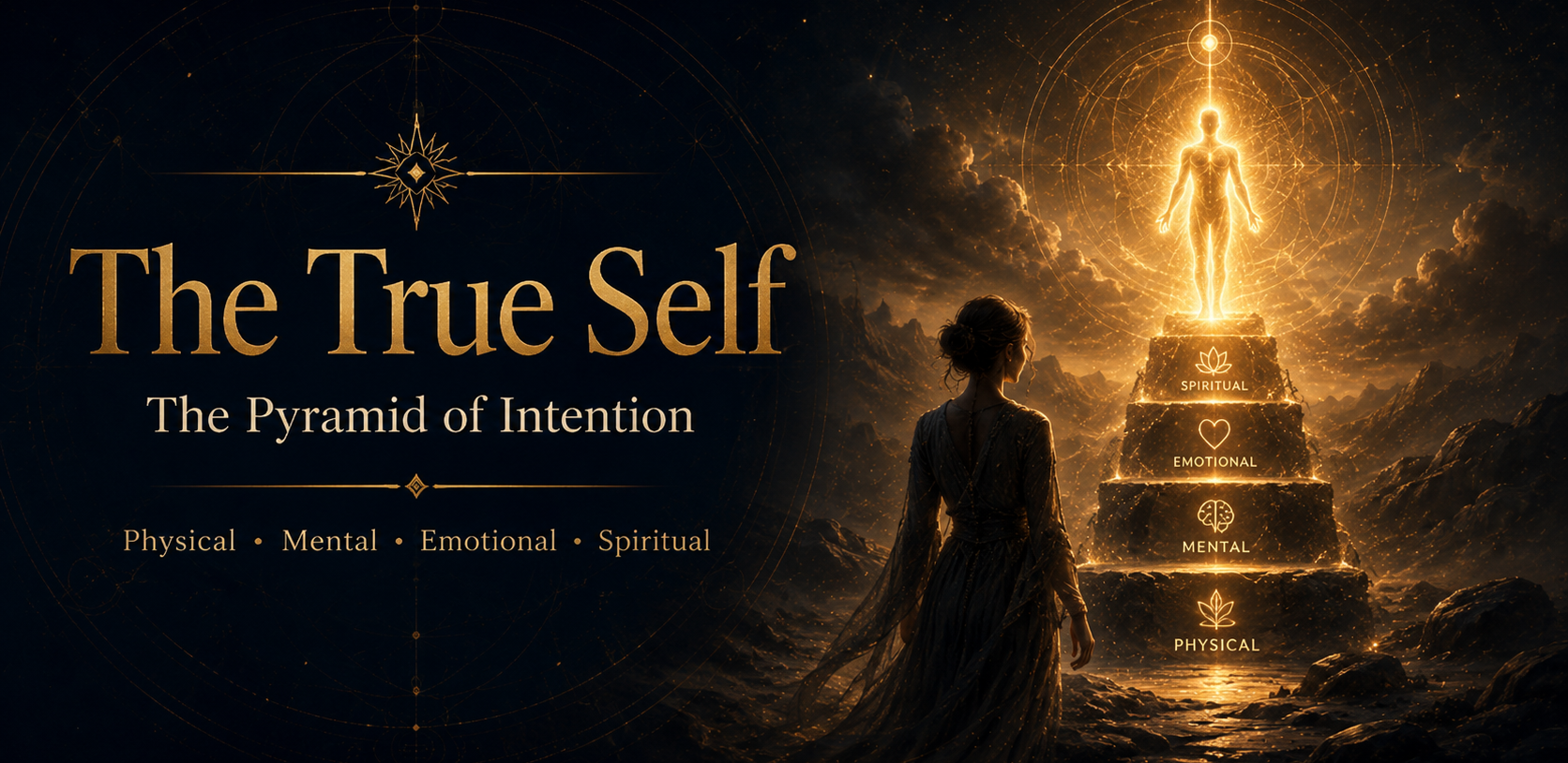
The True Self and the Pyramid of Intention
We spend an enormous amount of time thinking about what we don't want: what might go wrong, what we're afraid of, what needs to stop, and what we don't want to feel anymore. But when was the last time you deliberately imagined the person you actually want to be?
The Foundation
I Don't Start With What's Wrong With You
One of the first things I want to understand in a Soul Journey is not simply what you want to get rid of.
I want to know where you're going.
If anxiety disappeared, who would you be without it? If the old relationship pattern changed, how would you behave differently? If you trusted yourself more, what decisions would you make?
We begin building a version of you that may exist six months from now, several years from now, or even ten years into the future.
I call that version your True Self.
Not because there is one perfect version of you hidden somewhere waiting to be discovered, but because this is the person you are intentionally choosing to move toward.
Instead of only asking “What do I want to stop feeling?” we begin asking, “Who would I become if I were no longer organized around this problem?”
Looking Forward
Meet a Version of You Who Has Already Changed
Sometimes I keep the future close. Sometimes I stretch it much further. Both perspectives can reveal something different.
What Could Realistically Be Different?
Imagine yourself after six months of living with greater intention. How are you taking care of your body? How do you respond to stress? What boundaries have changed? What are you doing that you aren't doing today?
This makes the True Self immediate enough to begin acting on now.
Who Are You Becoming Over a Lifetime?
A longer horizon changes the question. What kind of person do you want to have become? What matters less? What matters more? What relationships surround you? What do you understand now that today's version of you hasn't learned yet?
Distance can sometimes make the direction much clearer.
The Pyramid of Intention
Four Parts of the True Self
I think of the True Self as a pyramid. Each level supports what comes above it. The spiritual part sits at the top, but it isn't where I begin.
The foundation is the physical body. Above that is the mental state. Then comes the emotional self. At the top is the spiritual self.
I don't see these as four unrelated categories. They influence each other.
When your body is exhausted, your thinking can change. When the mind is overwhelmed, emotions become harder to regulate. When you're disconnected from yourself emotionally, spiritual questions can become harder to hear clearly.
Rather than reaching immediately for something “higher,” we build from the ground up.
Building the Foundation
What Does Your True Self Actually Look Like?
The goal isn't vague positivity. We begin making the person you're becoming more specific.
Physical: Take Care of the Vehicle
Your physical body is the vehicle you have for this lifetime. I sometimes compare it to owning a car you want to carry you for 100,000 miles or more.
You wouldn't expect a vehicle to travel that distance while never maintaining it.
The same principle applies here. What does the version of you who intends to live a long, capable life do differently? How do they sleep? Move? Eat? Rest? Recover? What relationship do they have with their own body?
Spiritual exploration doesn't remove the reality that you're living through a physical body.
Mental: Clear Enough to Choose
Next we look at the mind.
What does your True Self think like? Not what do they think every second, but how do they relate to their thoughts?
Are they focused? Curious? Disciplined? Able to slow down before reacting? Can they recognize fear without letting fear make every decision?
A clearer mental state gives us more room for discernment, choice, learning, and perspective.
The goal isn't to never have a negative thought. It's to stop allowing every thought to become an instruction.
Emotional: How Do You Want to Feel and Relate?
Then we move into the emotional self.
For me, this includes self-love, empathy, kindness, compassion, emotional honesty, and the ability to extend some of those same qualities toward yourself.
Can you love someone and still have boundaries? Can you feel anger without becoming the anger? Can you recognize a hurt part of yourself without letting that part run your entire life?
Emotional strength isn't the absence of emotion. It's a different relationship with emotion.
Spiritual: Connection Beyond the Everyday Self
At the top of the pyramid is the spiritual dimension.
That may mean God, Spirit, Higher Self, guides, intuition, consciousness, nature, purpose, or simply the sense that your life belongs to something larger than your immediate thoughts and problems.
You don't have to define it the same way I do.
What matters is whether there is a meaningful connection beyond the constant noise of the everyday mind.
Why the Body Comes First
You Get One Vehicle for This Lifetime
I use the car analogy because it makes the idea simple.
If you wanted a car to reach 100,000 miles, you would think differently about maintenance. You would pay attention to what you put into it, how you drive it, what warning lights you ignore, and whether you service it before something breaks.
Our bodies are obviously more complex than cars, but the underlying idea works for me.
If your intention is to be here for a long life — maybe even moving toward 100 years — then this physical vehicle matters.
And when the body is functioning well, it can support the mental, emotional, and spiritual parts of the person you're becoming.
It is: What would taking better care of this vehicle look like for the version of me I'm choosing to become?
The Antenna at the Top
Spiritual Connection Needs a Foundation
I sometimes imagine an antenna sitting at the very top of the Pyramid of Intention.
The higher and more stable the foundation beneath it, the clearer the reception can become.
If the physical body is neglected, the mind is constantly overwhelmed, and the emotional world is chaotic, it can be difficult to tell the difference between intuition, fear, wishful thinking, old conditioning, and genuine inner guidance.
So I don't think spiritual growth is about skipping everything underneath it.
Why We Do This Before the Journey
Your True Self Gives the Session a Direction
Once we've built this version of you, we're no longer exploring blindly. We have an intention.
We define who you're becoming physically, mentally, emotionally, and spiritually.
The journey may move into a past life, an Inner Journey, a part of self, a guide, the Higher Self, or something unexpected.
We begin seeing what stands between the person you are today and the person you've decided you want to become.
The Other Half of the Work
Becoming Often Requires Letting Go
Once we know who you want to become, another question becomes possible:
What are you carrying that this version of you no longer needs?
Maybe it's an old identity. A fear. A promise you made to yourself when you were young. A relationship pattern. The need to please everyone. Anger that once protected you. A belief about what happens if you're truly seen.
This is one reason I create the True Self early in the work.
We're not just digging into the past to see what happened. We're looking at the past from the perspective of where you have decided you want to go.
The intention gives the exploration a compass.
Your Own Pyramid
Start With These Questions
Your Soul Journey
Know Where You Want to Go. Then Explore What's in the Way.
A Soul Journey doesn't begin by deciding what is wrong with you. We establish who you want to become, build the intention, and then allow your inner experience to show us what may need to be understood, released, reclaimed, or integrated.
Want to experience this process on your own first? My $27 Soul Journey Audio Course includes guided experiences that introduce the way I work with intention, inner awareness, and the True Self before a private session.