

Hypnosis · Symbolic Exploration · Inner Work
What Is an Inner Journey?
An Inner Journey is a guided exploration of your inner world using hypnosis, emotion, imagination, symbolism and focused awareness. Instead of deciding what you should experience, we turn inward and follow what begins to emerge.
Beneath the Surface
Not Every Journey Needs to Be a Past Life.
Sometimes what matters most is much closer to the life you are living right now.
An emotion may become a landscape. A frightened or protective part of you may appear. Someone from your life may show up. Fear might become a mountain. An obstacle may become a wall, canyon, locked door or something completely unexpected.
But our inner world is not only a place where we encounter what hurts.
It can also reveal strength, possibility, wisdom and versions of ourselves that have not yet been fully expressed.
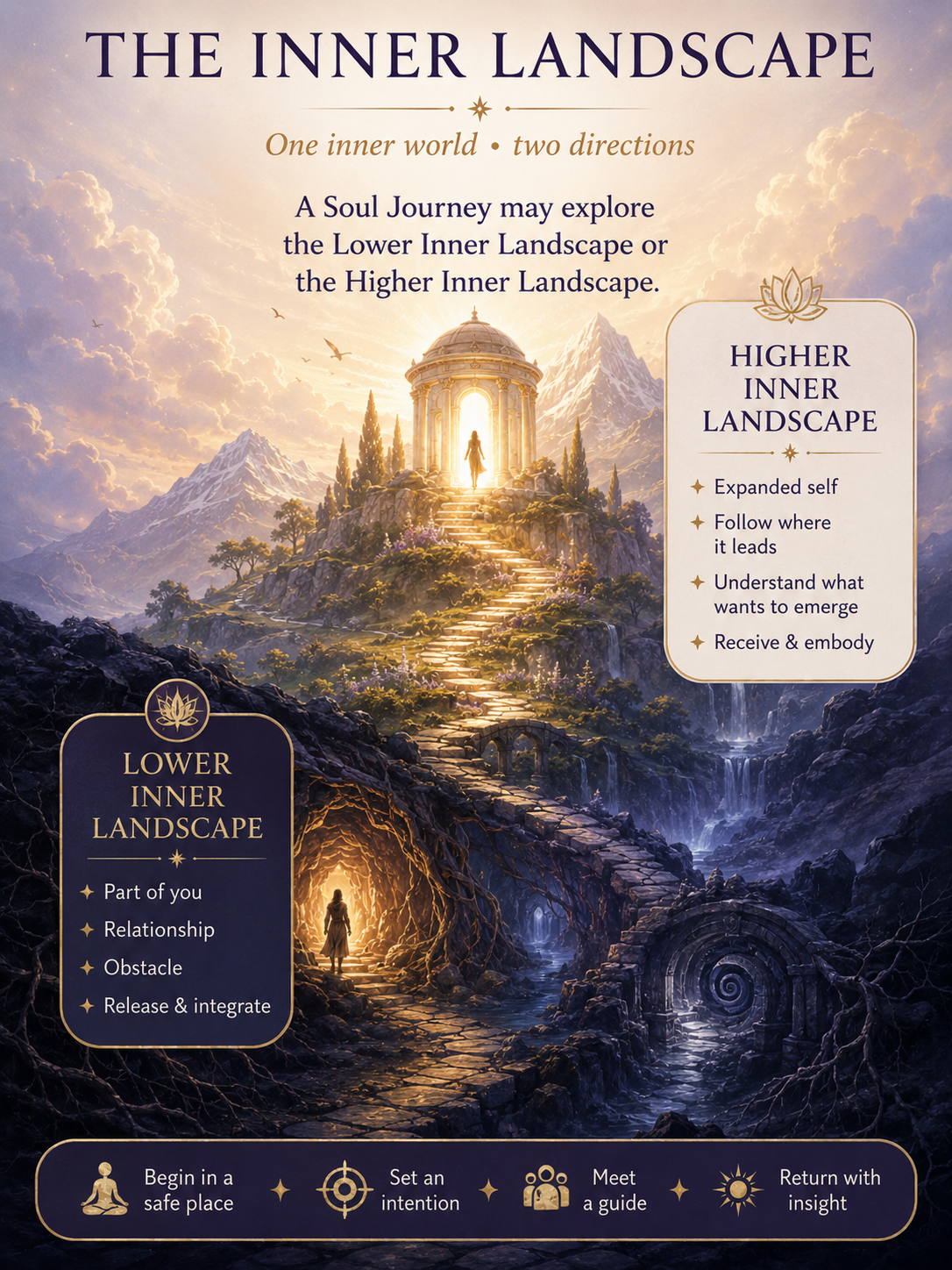
This is why I now think of the Inner Journey as having two directions: a Lower Inner Landscape and a Higher Inner Landscape.
One Inner World · Two Directions
The Lower & Higher Inner Landscapes
These are not two rigid scripts. They are two different ways of exploring what may be happening within you.
Understand What You Are Carrying.
The Lower Inner Landscape moves toward what may be unresolved, hidden, protected, avoided or emotionally unfinished.
You might encounter a fearful or grieving part of yourself, someone connected to an emotion you are carrying, an obstacle that seems to prevent you from moving forward, or a feeling of heaviness or energy that needs attention.
We don't enter this landscape to fight the shadow. We enter it to understand what it has been carrying, discover what may still be holding you back, and allow something to change.
What within me is ready to be understood, released or integrated?
Discover What Is Trying to Emerge.
The Higher Inner Landscape moves in another direction. Instead of beginning with what needs to be released, we explore what may be waiting to develop.
You may encounter an expanded version of yourself: a version who seems more peaceful, courageous, connected, confident, creative or simply more fully themselves.
Rather than only asking this version questions, we may allow them to become a guide and lead you toward whatever you need to see, experience or understand in order to move closer to that way of being.
What within me is ready to grow, emerge or be expressed?
Before the Landscape
How the Journey Begins
We don't begin by dropping you immediately into a problem. We first create a foundation for the journey.
Intention
We talk about what is happening in your life and who you would like to become moving forward.
Safe Place
Hypnosis, breathing and focused awareness help you settle into an internal place that feels safe.
Guide
You may encounter a guide, presence, symbol or another form of inner support before moving deeper.
Explore
From there we move beyond the Safe Place and allow the journey to show us where it wants to go.
The Lower Inner Landscape
Moving Through What Has Been Holding You Back
Every journey is different, but the Lower Inner Landscape often moves through several layers of an emotional experience.
A Part of You
An emotion may take form as a younger self, fearful part, grieving part, angry part, protector or another aspect of you. Rather than immediately trying to remove it, we listen and understand what it has been carrying.
A Relationship
The journey may reveal a relationship connected to the emotion: a parent, partner, child, friend, someone from your past, or even someone who has died. We explore what may still feel unfinished.
The Obstacle
Something may appear between you and where you want to go. A wall, mountain, canyon, locked door, storm, cage, deep water or another symbolic barrier may represent what has been preventing movement.
Release & Return to Light
Near the end, we may scan the landscape and the body for anything that still feels connected to that environment. What no longer needs to be carried may be released, transformed or integrated as you move out of the landscape and toward light.
The Higher Inner Landscape
Following the Part of You That Already Knows the Way
The Higher Inner Landscape is not simply positive thinking or imagining a perfect future. The experience is allowed to unfold through the same symbolic and intuitive process.
Meet an Expanded Version of Yourself
Somewhere within the landscape you may encounter a version of yourself who seems to have grown beyond where you are today. We notice how they carry themselves, what feels different about them and what they seem to understand.
Let Them Lead
Instead of deciding what you need to learn, this expanded version of you can become the guide. We ask them to take you somewhere you need to go or show you something you need to understand in order to become more like them.
Experience What You Need to Understand
They may lead you to a relationship, a symbolic place, a challenge, a forgotten strength, a possible life scene, an object, a choice or something completely unexpected. We follow what appears and discover why you were brought there.
Receive & Embody
Before returning, there may be something for you to receive: a symbol, message, feeling, object, quality or simply a new understanding. Rather than leaving the expanded self behind, we may explore what it feels like to embody more of that version of you now.
Two Different Questions
Release What Limits You. Discover What Is Possible.
Freedom From
What am I carrying? Why am I carrying it? What needs to be understood? What am I ready to release or experience differently?
Freedom To
Who am I capable of becoming? What part of me wants expression? What do I need to understand or experience in order to move toward that person?
Your Experience Is Your Own
Does This Have to Be Spiritual?
No.
You may understand the entire Inner Journey psychologically: your unconscious mind communicating through emotion, imagination, memory, sensation and symbolism.
Or the experience may feel spiritual. A guide may appear. Someone who has died may appear. You may experience energy, a presence, intuitive information or something that is difficult to explain through ordinary language.
I don't need to decide what your experience is for you. It can be psychological, symbolic, spiritual, or contain elements of all three.
Common Questions
What If I'm Not Sure I Can Do This?
What if I feel like I'm making it up?
Imagination may absolutely be part of the process. That doesn't automatically make the experience meaningless. If your mind creates a particular landscape, person, obstacle or symbol, we become curious about why that specific experience appeared and what it may be expressing.
What if I can't visualize clearly?
Clear pictures are not required. Some people see vivid imagery. Others feel emotion or body sensations, hear internal words, sense movement, imagine possibilities, or simply know what is happening without seeing it clearly.
Do I choose the Higher or Lower Landscape beforehand?
Not necessarily. We begin with your intention and allow the journey to develop. Sometimes one direction becomes obvious. Sometimes the experience may move through more than one landscape during the same session.
What if past lives aren't really my thing?
That is one of the reasons the Inner Journey exists. You can explore emotional patterns, relationships, parts of yourself, symbolism, personal growth and deeper inner experience without needing to interpret anything as a past life.
The Bigger Picture
The Inner Journey Is One Direction a Soul Journey Can Take.
You are not booking a completely separate type of session. The Soul Journey is the full experience.
We begin with you, establish an intention, enter hypnosis, create a Safe Place and begin exploring. From there the journey may move toward a past life, an Inner Journey, a guide, Higher Self experience, symbolic material or something completely unexpected.
You do not have to know exactly where you need to go before you begin.
Begin Your Journey
What Are You Ready to Understand — or Become?
You don't need previous hypnosis experience. You don't need a particular spiritual belief. And you don't need to know exactly what your journey is going to show you.
We begin with where you are now, who you want to become, and enough curiosity to explore what is waiting beneath the surface.
Private Sessions · Las Vegas · Zoom Worldwide