One of the things I've noticed over the years doing Soul Journey sessions is how differently people can respond to something once they're able to experience it as separate from themselves.
Someone might be struggling with anxiety, fear, or a belief they've carried around for much of their life. But when I invite them to imagine that feeling as something outside of themselves, something interesting can happen.
What initially felt like an overwhelming emotion might become an animal, an object, a cloud of energy, or even a younger part of themselves.
And now they're no longer completely caught up in the feeling. They're looking at something that represents it.
They can approach it, move away from it, ask questions, or simply observe it.
Sometimes that alone begins to change the experience.
I've always found this fascinating because we tend to identify so strongly with whatever is happening inside our minds. We have an anxious thought, and suddenly we're anxious. We have a thought that we're not good enough, and we start treating it as though it's a fact.
But what if thoughts were more like things we encounter rather than things we are?
Interestingly, one of the most influential figures in modern psychology explored something very similar.
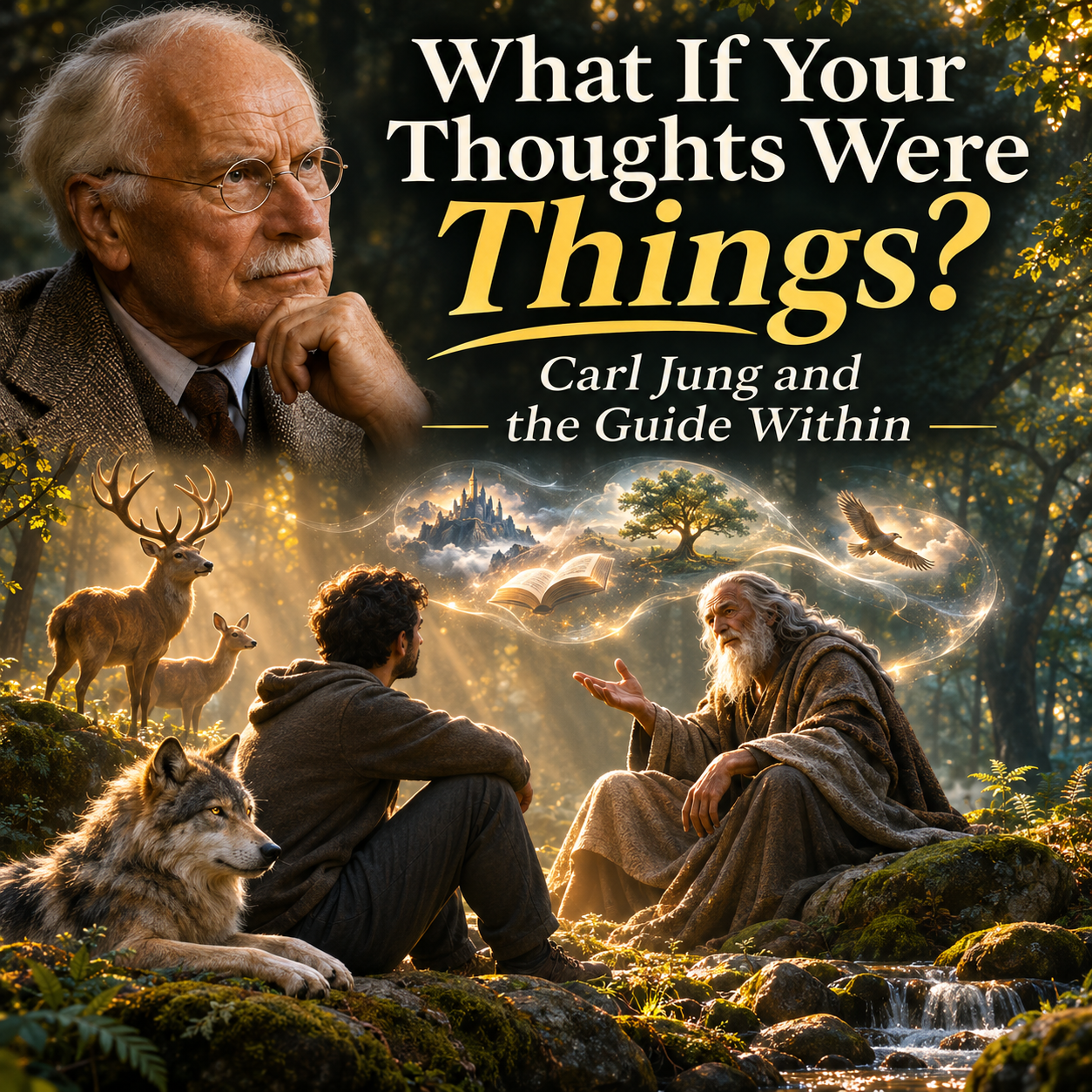
His name was Carl Jung, and he had his own inner guide.
Carl Jung and His Inner Guide

If you're unfamiliar with Jung, he was a Swiss psychiatrist and one of the pioneers of modern psychology. He studied dreams, archetypes, symbolism, and the unconscious mind. He was also deeply interested in spirituality and the mysteries of human consciousness.
What I've always appreciated about Jung is that he was willing to explore experiences that didn't necessarily fit into conventional scientific explanations.
During a particularly intense period of his life, Jung began exploring his unconscious through a process he later called active imagination. He would consciously enter into inner experiences, encounter figures, and have conversations with them.
One of these figures was a wise elderly man named Philemon.
Jung described Philemon as a teacher who sometimes expressed ideas he hadn't consciously considered himself. Philemon seemed to have his own personality and understanding, independent of Jung's ordinary thinking.
I find that remarkable.
Here was a scientifically trained psychiatrist, someone who helped shape our understanding of the human psyche, actively communicating with an inner guide and taking those experiences seriously.
If you've ever had a Soul Journey session with me, this might sound familiar.
I often invite people to connect with a guide during their journey. Sometimes that guide appears as a person, an animal, a presence, or simply a sense of knowing.
Is it an expression of our unconscious mind? A wiser aspect of ourselves? Or perhaps something more spiritual?
I don't know. I'm comfortable leaving that question open.
What's interesting to me is the experience itself and what we can learn from it.
And one of the things Philemon taught Jung was a rather unusual way of looking at thoughts.
What If Thoughts Were Like Animals in a Forest?

In his book Memories, Dreams, Reflections, Jung described how Philemon suggested that thoughts were like animals in a forest, people in a room, or birds flying through the air.
Think about that for a moment.
If you're walking through a forest and encounter an animal, you don't assume you created that animal.
If you walk into a room filled with people, you don't believe you're responsible for everyone being there.
And when you look up at birds flying overhead, you don't feel compelled to follow every single one of them.
They're simply part of the environment you're experiencing.
What if we approached our thoughts in a similar way?
Instead of automatically identifying with every thought that enters our awareness, imagine that thoughts are things appearing around us.
Some are pleasant. Some are interesting. Others might be frightening, irritating, or simply something we'd rather not have around.
But here's where I think this becomes useful.
Imagine you're experiencing a recurring thought that's causing anxiety.
Normally, that thought feels like it's happening somewhere deep inside you. You become absorbed in it. The thought creates an emotional response, which produces more thoughts, and before long you're caught up in the whole experience.
Now imagine giving that thought a form outside of yourself.
Perhaps it's an animal that's wandered into your space.
What would you do?
Would you back away? Gently shoo it away? Maybe you'd imagine creating a fence or some kind of protective boundary between yourself and the animal.
Or perhaps you'd just sit quietly and observe it.
Now consider something else.
What if that animal isn't actually threatening you? What if it's frightened itself?
Maybe it represents a part of you that's been trying to protect you from something.
This is where the experience can take an entirely different direction.
Instead of trying to get rid of the thought, you might become curious about it.
Why is it here? What does it want? Is there something it needs?
You've gone from being caught up in the anxiety to observing something that represents it.
That separation is important.
And it doesn't matter whether you actually see an animal, sense an energy, imagine an object, or simply recognize a part of yourself. You don't even need to visualize anything clearly.
The imagination gives us a way to experience something that previously felt inseparable from us as something we can observe and interact with.
What Would Your Guide Say?

This is where I like to take the experience a little further.
Imagine you've given that uncomfortable thought a form. Maybe it's a frightened animal, a younger part of yourself, or something you don't quite understand.
Now imagine inviting a wise guide to join you.
Much like Jung did with Philemon.
Perhaps it's someone you recognize, a spiritual teacher, or simply a wiser aspect of yourself. Someone who can look at what you're experiencing without being caught up in the same emotions.
You might ask your guide:
What am I looking at?
Why does this thought keep showing up?
Is there something this part of me is trying to communicate?
What would you suggest I do?
And then notice what comes to mind.
Perhaps your guide suggests moving away and creating some distance.
Maybe they encourage you to approach whatever is in front of you with compassion.
Or perhaps they help you recognize that what initially appeared threatening is actually a frightened part of yourself that's been carrying an old experience for years.
This is something I've encountered in different forms during sessions. What initially seems like an obstacle can sometimes turn out to be a protective part, something that developed long ago to help a person avoid pain, rejection, or disappointment.
That doesn't mean we have to agree with what this part is telling us. But understanding it can sometimes change how we relate to it.
And not every thought needs this kind of attention.
Some thoughts really are just passing through, and we can let them go.
Others seem to keep returning. Those might be worth exploring.
What I appreciate about inviting a guide into the experience is that we're giving ourselves an opportunity to consider a different perspective. Maybe something arises from our unconscious that we hadn't considered before.
We don't have to treat every answer as some profound truth. We can simply remain curious about what comes up and whether it offers anything useful.
A Different Relationship With Our Thoughts

There's a connection here with Buddhist meditation and what Eckhart Tolle discusses in The Power of Now. Both encourage us, in different ways, to become aware of our thoughts without being completely identified with them.
But I like the idea of taking this a little further through imagination.
Instead of simply noticing a thought and allowing it to pass, we can choose how we want to interact with it.
Maybe we create some distance. Maybe we establish a boundary. Perhaps we discover that the thing we've been trying to push away is actually a part of ourselves that needs a little understanding.
And sometimes we might invite a guide to help us explore what we're experiencing.
You don't have to believe that thoughts literally exist outside your brain or that an inner guide is a separate spiritual being. You can approach this entirely as a psychological exercise, or you can explore it from a spiritual perspective.
The interesting part is what happens when you try it.
And you don't need to be in hypnosis or a deep meditative state to experiment with this.
The next time you find yourself caught up in an uncomfortable thought, try giving it some space.
Imagine it sitting a few feet in front of you.
Let it take whatever form seems natural.
Notice how different it feels to look at the thought rather than be completely absorbed in it.
Does it need your attention? Does it need some distance? Is there something worth understanding?
And if you're not sure, imagine inviting a wise guide to sit beside you.
What might they suggest?
I keep coming back to Jung and Philemon because I find the whole experience fascinating. Here's a man who spent his life studying the mind, yet some of his most meaningful insights came from exploring an inner world that he didn't completely understand.
He was willing to be curious about what he encountered.
I think there's something valuable in that.
And I like Philemon's analogy of the forest.
Imagine sitting quietly among the trees, watching the birds overhead and the animals moving around you.
Some might catch your attention. Others might come a little too close. Occasionally, you might encounter something you want to understand better.
But you don't have to follow everything that moves.
And maybe, sitting there beside you, is a wise old guide who can help you decide what deserves your attention.
If you're curious about exploring your own inner world, you're always welcome to book a private Soul Journey session with me.
I also have a Soul Journey Audio Course that you can explore at your own pace. It includes guided journeys to help you discover your own safe place, connect with an inner guide, and begin exploring some of these experiences for yourself.
If you haven't tried it yet, I'd encourage you to give it a listen. You might be surprised by what you discover when you give yourself a little space to explore.