It's been about a week since my last ayahuasca journey, and something I've noticed is how quickly the feeling of a profound experience can begin to fade.
Not necessarily what you learned from it, but the feeling itself.
That sense of connection, clarity, peace and being completely present. When you're in that space, everything seems a little different. The things you normally worry about don't carry quite the same weight. You feel more connected to yourself, to nature, to the people around you, and perhaps to something much greater than yourself.
Then you come home.
There's work to do, bills to pay, people to deal with, and all the normal responsibilities that come with being alive. Maybe something unexpected happens. Someone is having a bad day, or you find yourself getting frustrated over something that wouldn't have bothered you a few days earlier.
And before you know it, some of that magic seems to have disappeared.
I've experienced this enough times, both personally and through the spiritual work I do with others, to know that this is often where the real work begins.
Coming Back to Everyday Life
A few days after my journey, I found myself sitting out at Red Rock, in a place that has always felt sacred to me.
I went there intentionally. I wanted to spend some time alone, reflect on the experience and remember how I was feeling.
Something had shifted during the retreat.
I felt unusually sensitive to my emotions and to the emotional atmosphere around me. Negative attitudes, certain conversations and familiar patterns of thinking seemed to affect me more deeply than usual.
The best way I could describe it at the time was that some kind of protective film had been peeled away.
Things I normally wouldn't think twice about suddenly felt uncomfortable. Almost toxic.
At the same time, positive experiences felt stronger too. Being outside, sitting quietly, having a meaningful conversation, feeling connected to people. There was a heightened awareness of both.
I remember thinking that the medicine had somehow raised my internal frequency.
Now, I realize that word can mean different things to different people. I'm not suggesting there was some measurable energetic change. It's simply how I experienced it.
It felt as though a lot of the normal mental and emotional weight I carry had been lifted, and underneath was a calmer, clearer version of myself.
Of course, I wanted to keep that feeling.
And that's where things get interesting.
The Fire We Carry Home
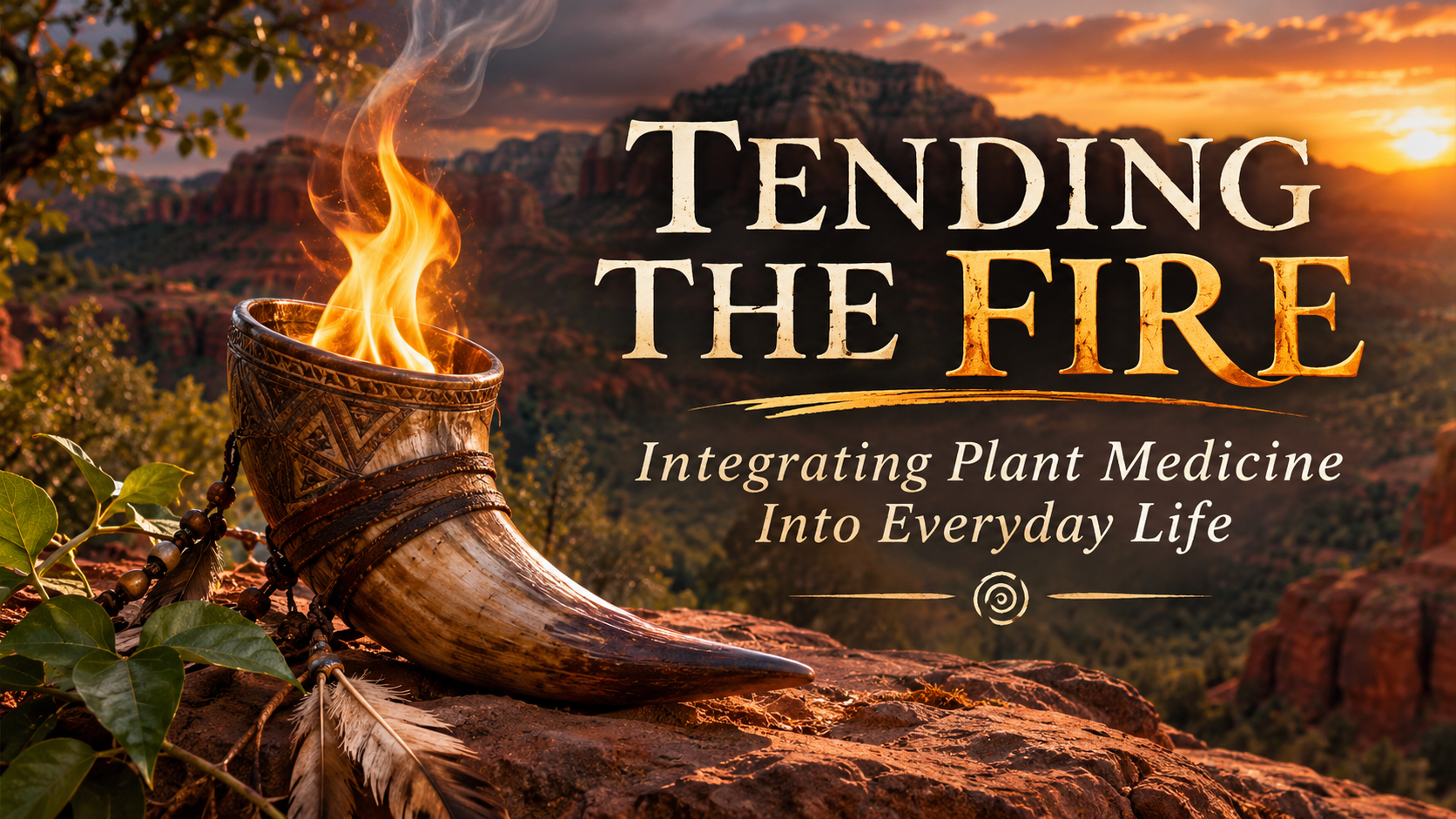
During those first few days, I kept coming back to an image of people long ago carrying fire from one camp to another.
Rather than starting a new fire every time, they could protect an ember and carry it with them.
That image seemed to capture what I was feeling.
A profound spiritual experience can light something within us. Maybe it's a deeper awareness, a sense of connection, or simply the realization that we've been carrying around thoughts and habits that aren't really serving us.
Whatever it is, we want to bring it home.
But a fire needs attention.
And I think that's what integration is really about.
Not recreating the experience. Not trying to remain in some heightened spiritual state forever. Just finding small ways to keep that connection alive within us.
What's interesting is that a week later, my understanding of this has already changed a little.
Initially, I felt like I needed to protect this new state of awareness. I was especially conscious of the environments I entered, the conversations I entertained and the emotions of the people around me.
I still think those things matter.
But I'm beginning to see that integration isn't really about protecting myself from everyday life.
It's about learning how to remain connected to myself while participating in it.
That's a different kind of practice.
Learning to See the Wave
One experience from those first few days has stayed with me.
I noticed an old emotional pattern beginning to return. It was something familiar, one of those reactions that can quietly take over before you even realize what's happening.
But this time, I noticed it earlier.
I pictured it like an ocean wave coming toward me.
Normally, when we're caught in a negative thought pattern, we don't necessarily recognize what's happening. One thought creates another. An emotion follows, and suddenly we're completely absorbed in whatever story the mind is telling us.
But when you recognize the wave coming, you have a choice.
You can let it hit you, or you can dive underneath it.
That's what I did.
And I think this is one of the most valuable things we can develop through meditation, hypnosis, spiritual journeys, or any form of inner work.
Awareness.
Not the ability to eliminate difficult emotions or stop negative thoughts from appearing, but the ability to recognize them without automatically becoming them.
I've spent years exploring this in my work with clients, and yet I still find myself learning the same lessons in my own life.
Knowing something intellectually and actually living it are two very different things.
When the Magic Starts to Fade
Now that about a week has passed, I can feel some of that initial intensity settling down.
The world doesn't feel quite as extraordinary as it did in those first few days.
I'm not constantly walking around feeling deeply connected to everything. My mind gets busy. I get distracted. I fall into familiar habits, sometimes without realizing it until afterward.
And for a moment, there's a temptation to think I've lost something.
But have I?
I don't think so.
I'm beginning to see that what felt like the magic fading might simply be life returning to normal.
The experience itself was temporary. The feelings were temporary. Even the heightened awareness I experienced afterward may settle into something much quieter.
That doesn't mean the experience wasn't meaningful.
In fact, this is probably where its meaning becomes more apparent.
Can I remember what I learned when I'm having a difficult day?
Can I recognize an old emotional pattern before it takes over?
Can I return to that calmer place within myself without needing another retreat, another ceremony or another extraordinary experience?
I think that's the real measure of integration.
Not how amazing we feel immediately afterward, but how we gradually begin to relate to everyday life.
Coming Back to Our Spiritual Core
One thing I've realized over the past week is that I already know how to return to that inner space.
I've been practicing different forms of meditation, self hypnosis, breathwork and spiritual exploration for much of my life.
And I still forget.
I get caught up in responsibilities, distractions and whatever happens to be demanding my attention.
Sometimes I can spend an entire day moving from one thing to another without really taking a moment to be present.
Then I remember.
Maybe I sit quietly for five minutes. Maybe I close my eyes and focus on my breathing. Sometimes I go outside, read a few pages of a good book, or simply remind myself of the intention I set during my journey.
It doesn't have to be complicated.
What I'm trying to reconnect with isn't really the ceremony or the medicine. It's that calm, steady place within myself that was easier to recognize during the experience.
My spiritual core, if you want to call it that.
And the interesting thing is, I don't believe that place ever really goes away.
Our attention just moves somewhere else.
We get caught up in thoughts, worries, emotions and all the little things that make up our daily lives.
The practice is learning to come back.
Integration Doesn't Have to Be Complicated
I think we sometimes make spiritual growth into another thing we're supposed to accomplish.
We have intentions to follow, habits to change, meditations to complete, books to read and a better version of ourselves we're constantly trying to become.
There's value in all of that.
But it can also become another source of pressure.
We have a beautiful spiritual experience and then place this enormous expectation on ourselves to somehow maintain it.
And when we inevitably have a difficult day, we feel like we've failed.
I don't think that's particularly helpful.
What if integration is simply a mindful practice?
We remember our intentions. We try to make better choices. We pay attention to our thoughts and emotions. We recognize when we've slipped into an old habit and make a conscious decision to return.
Sometimes that return takes a few seconds.
Sometimes it takes a few days.
I don't think it matters nearly as much as we imagine.
There's no perfect state we're supposed to maintain.
Even the most experienced meditators still have thoughts. People who have spent decades doing spiritual work still get frustrated, impatient and caught up in their own stories.
I certainly do.
The difference, perhaps, is that we become a little more aware of what's happening.
And awareness gives us an opportunity to respond differently.
The Medicine Is a Teacher, but Life Is the Practice
I've sat with ayahuasca around twelve or thirteen times now, and my relationship with the medicine has changed over the years.
For me, it's more than just an experience. I relate to it as a teacher.
I understand that might sound strange to someone who hasn't worked with plant medicine, and I don't expect everyone to interpret these experiences the same way.
Some people understand them spiritually. Others see them through a psychological or neurological lens.
I'm comfortable leaving room for both.
What matters most to me is what I take away from the experience and how I apply it to my life.
And I should also say that ayahuasca isn't for everybody. These experiences can be psychologically and physically challenging, and there are real medical and medication-related risks. I don't believe anyone needs plant medicine to access meaningful inner awareness.
I've seen people experience profound shifts through hypnosis, Past Life Regression, meditation, prayer and other forms of inner exploration.
The methods may be different, but the challenge afterward is often remarkably similar.
How do we bring what we've experienced into the life we're already living?
I don't think the answer is to keep searching for increasingly profound experiences.
At least, not for me.
The answer seems to be learning how to practice what those experiences have shown us.
Tending the Fire, One Day at a Time
When I first sat down at Red Rock to write my thoughts, I felt like I was carrying something precious that I didn't want to lose.
A flame.
I wanted to protect it from old habits, negative emotions and the distractions of everyday life.
A week later, I still like that image.
But I think I understand it a little differently now.
Tending the fire doesn't mean standing guard over it every moment of the day.
It means remembering that it's there.
Sometimes it burns brightly. Other times it settles into a small ember.
And when life gets busy and I forget about it for a while, I don't need to start everything over.
I can sit down.
Take a few breaths.
Find that quiet place within myself.
And remember.
Maybe this is what I've been learning all along, through the medicine, through my work with others, and through my own experiences.
Life itself is the practice.
Not just the meditation. Not just the ceremony. Not just the moments when everything feels connected and peaceful.
The ordinary moments too.
The difficult conversations, the frustrations, the distractions, the times when we lose our patience or fall back into an old pattern.
All of it gives us another opportunity to become aware.
And then to come back.
That's where I am a week later. The magic of the experience may not feel quite as strong, but I think I'm beginning to appreciate something a little more useful.
I don't have to hold on to the experience.
I just have to keep practicing what it taught me.
Share Your Experience
If you've had your own experiences with plant medicine, I'd be interested to hear how you've approached integration afterward. What helped you bring those experiences back into everyday life? Did you find it challenging to maintain that sense of connection, or did your perspective change over time?
Feel free to share your thoughts or experiences in the comments.