The Past Life Nobody Would Choose
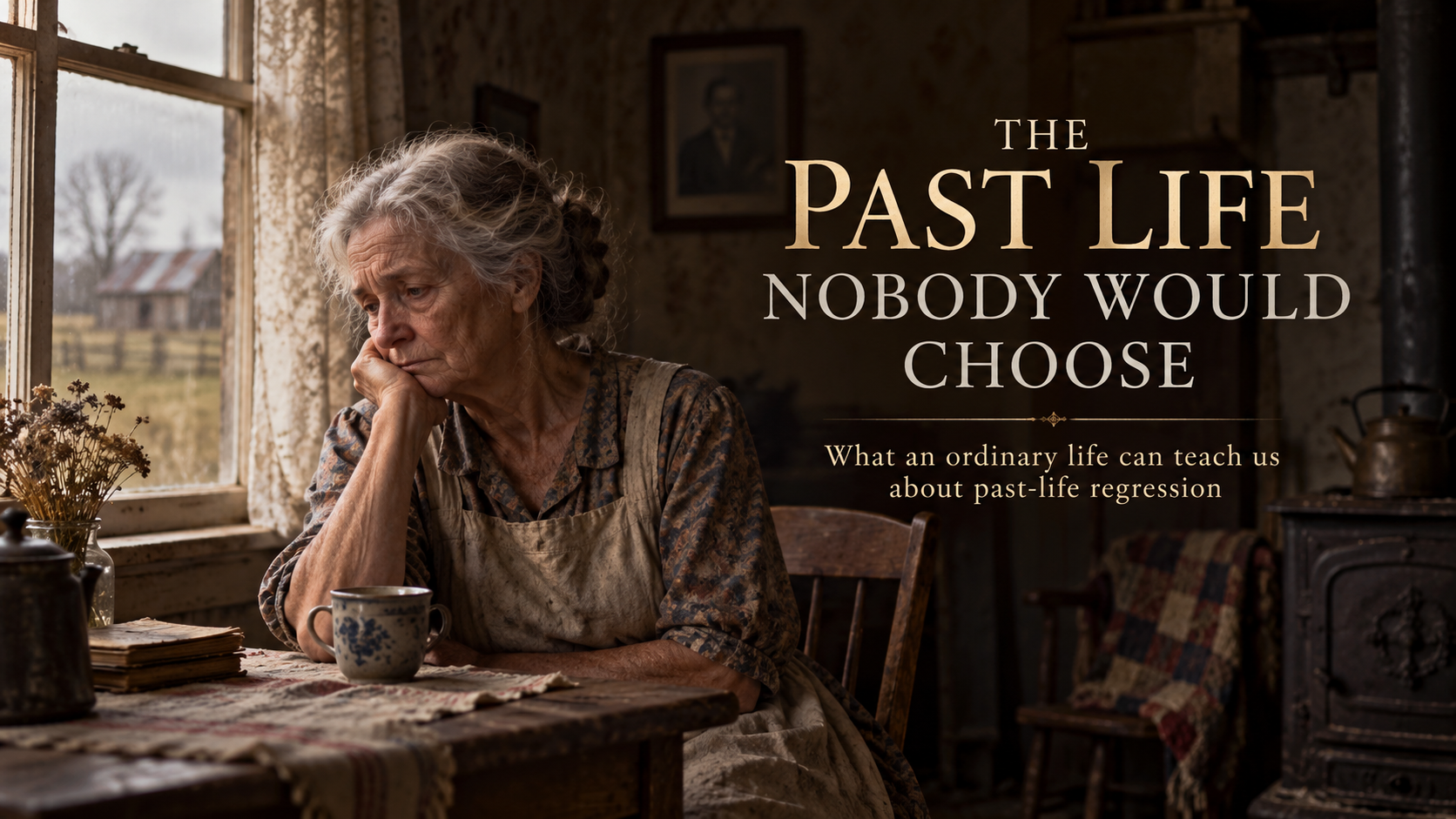
One of the things I find interesting about past-life regression is that people sometimes expect the experience to be extraordinary.
Maybe they were someone famous. Maybe they lived in ancient Egypt. Maybe they were a healer, a warrior, royalty, or someone who had some obvious purpose that explains everything about who they are today.
Sometimes that happens.
But sometimes the life that comes through is completely ordinary.
I recently worked with a client who was only twenty-four years old. She came from a Christian background and still had a connection to that faith, but she was also open-minded enough to explore the possibility of past lives. I think that matters because you don't necessarily have to abandon what you already believe in order to become curious about something else. She wasn't coming in trying to prove reincarnation. She was simply willing to see what happened.
What happened was a life I don't think anyone would have chosen to invent.
She experienced herself as an eight-year-old girl named Maria, living in what appeared to be Kentucky sometime in the 1930s. Maria had run away from home after breaking a glass and being yelled at by her father. She ended up hiding in a neighboring barn, frightened and upset. There was nothing spectacular about the scene. No great historical event. No mystical revelation. Just a scared little girl sitting alone because her father had frightened her.
As the life moved forward, Maria grew up and married a man named John who lived on another farm nearby. On their wedding day she was happy, but the marriage changed over time. Money became tight, John became withdrawn, and during one scene he became angry because something she was cooking had burned. He threw a glass at her.
That detail caught my attention because a broken glass had also been part of the childhood scene with her father. I didn't need to interpret it. The repetition was simply there.
The rest of Maria's life became increasingly difficult. John eventually died in an accident, and Maria's first reaction was relief. Then she felt guilty for being relieved. She had a son she loved deeply, but he badly injured his leg as a teenager, eventually lost the leg, and struggled into adulthood. Maria carried more and more guilt, feeling as though she had failed to protect him or provide enough for him.
Eventually her son took his own life.
Maria was the one who found him.
After that, her life seemed to collapse inward. She became isolated, grew old in the same house, and eventually died there alone. Her final thought was simple:
"Should have done more."
That line stayed with me because so much of Maria's life seemed to revolve around taking responsibility for things she couldn't fully control. Her father's anger. Her marriage. Her husband's death. Her son's injury. His emotional decline. His suicide.
Even at the end of her life, she still believed she should have done more.
Why This One Felt So Real to Her
After the session, my client was surprised by what had come through.
So was I.
Kentucky. A farm. A broken glass. A difficult marriage. An injured son. An amputation. A suicide. An old woman dying with regret.
It was oddly specific, but at the same time completely ordinary.
I remember saying something to her along the lines of: if I had given you the opportunity beforehand to invent a past life, would this really have been the story you came up with?
Her response was basically, no. There was no way she would have made that up.
That doesn't prove it was a past life. I don't think we need to make that leap.
But I do think the randomness is interesting.
The life wasn't glamorous enough to feel like wish fulfillment. There was no obvious reason to choose it. It was actually pretty sad and depressing.
And yet emotionally, it was riveting.
That's the part I think people misunderstand about this work. A past life doesn't have to be extraordinary to be meaningful. In fact, sometimes the most ordinary lives carry the clearest lessons because they look so much like our own.
Maybe Ordinary Is the Point
After Maria died in the session, she eventually came to a realization that she couldn't have fixed everything that happened. She had spent a lifetime carrying guilt and responsibility for situations that were bigger than her.
Her message to my client afterward was simple:
Have the right people around you. Have strong bonds with those around you.
After everything Maria had lived through, that was what remained.
Not status.
Not achievement.
Not whether anyone remembered her.
Relationships.
The people around you.
The connections you build while you're here.
I think there is something important in that.
We tend to imagine that if we discovered a past life, the value would be in finding out that we were someone important.
Maybe the opposite is true.
Maybe the value is realizing that an ordinary human life can still contain fear, love, regret, guilt, loss, resilience and lessons that continue to matter.
Most people who have ever lived were not famous.
They raised families. They struggled financially. They married people. They lost people. They made mistakes. They worried. They hoped. They died wondering whether they had done enough.
If reincarnation is real, statistically, that is probably much closer to what most of our past lives would look like.
You Don't Have to Decide What It Was
My client came into the session with a Christian background, and I appreciated that she was open enough to explore the experience without feeling that she had to immediately abandon one belief system for another.
I think that's a healthy way to approach this work.
You don't have to walk into a session already convinced that reincarnation is real.
Maybe Maria was a previous incarnation.
Maybe the unconscious mind created a story around emotions and patterns that were relevant to my client.
Maybe consciousness works in ways we still don't understand.
I'm comfortable not knowing.
What mattered was that the experience affected her.
She felt this woman's fear, guilt, grief and eventual relief. She came out of the session feeling that the story had given her something she could use in her own life.
And in the end, maybe that's the more interesting question.
Not:
Was I someone important?
But:
What did this life have to teach me?
Maria was not famous.
Her life wasn't glamorous.
It wasn't even particularly happy.
But for a short period of time, my client experienced that life as if it mattered enormously.
And maybe that's exactly the point.